Commercial Solar Maintenance: What NJ Facility Managers Need to Know

Commercial Solar Maintenance: What NJ Facility Managers Need to Know
Commercial solar systems are designed for 25 to 30 year operational lifespans. Over that horizon, maintenance quality determines whether the system continues producing at expected levels — or quietly underperforms while production guarantees go unclaimed. Here’s what NJ facility managers need to know about commercial solar O&M.
The Five Things That Need Active Management
- Production monitoring — 24/7 per-inverter performance tracking with deviation alerts
- Physical inspections — at least 4 annual visual + thermal imaging surveys
- NJ SuSI quarterly reporting — required for ongoing credit payments from NJBPU
- Warranty administration — manufacturer warranty claims for failing components
- Production guarantee enforcement — comparing actual vs PVsyst-modeled production
What Continuous Monitoring Catches
Without monitoring, system underperformance is invisible until you notice your utility bill didn’t drop as expected. Good monitoring catches:
- Per-inverter performance deviation (early failure detection)
- String-level current variance (failing module identification)
- Inverter fault codes — auto-clearing vs persistent
- Communications uptime (data flow integrity)
- Soiling and vegetation growth via production trends
Most commercial inverters have 10 to 15 year service life. Module degradation is 0.5%/year for tier-1 panels. Without monitoring, you can lose 10-15% of production over a decade without knowing it.
NJ SuSI Quarterly Reporting
For systems registered under the Successor Solar Incentive program, NJBPU requires quarterly metered production reports for ongoing credit payments. Missing the reporting window can interrupt credit issuance — which represents real revenue. For a 250 kW system at typical SuSI rates, missed credits cost approximately $7,000 per quarter.
Our standard O&M contract includes filing these reports on your behalf. Self-managed O&M is possible but adds administrative burden during a quarterly cycle most facility managers don’t have bandwidth for.
Annual Visual + Thermal Inspections
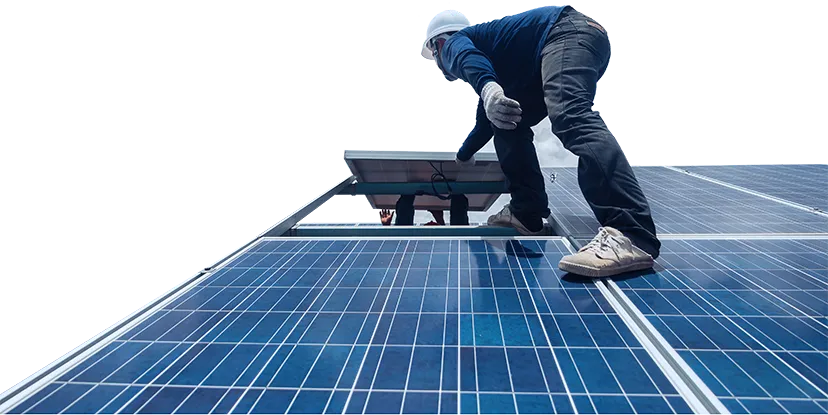
Four times per year, an O&M technician should be on your roof or ground-mount site for:
- Visual inspection of all modules (cracking, delamination, hot spots, discoloration)
- Thermal imaging survey (infrared camera) of all strings and inverters
- Inverter inspection — ventilation, capacitor health, firmware verification
- BOS (Balance of System) inspection — combiners, disconnects, grounding
- Racking and ballast inspection
- Roof condition check around penetrations
- Vegetation review
Warranty Claim Administration
Manufacturers (Q CELLS, REC, Silfab for modules; SolarEdge, SMA, Enphase for inverters) have specific RMA procedures for warranty claims. Missing the documentation window or failing the inspection requirements can void warranty coverage on individual components — turning a $0 replacement into a $2,000-$5,000 out-of-pocket cost.
Production Guarantee Enforcement
A production guarantee is only valuable if you can prove the threshold is missed. Without monitoring data, comparing actual vs PVsyst-modeled production is impossible. With monitoring, the annual reconciliation is straightforward:
- Year 1-2: guaranteed 95% of PVsyst model
- Year 3-10: guaranteed 90% of PVsyst model
- If actual falls below threshold and cause is addressable (soiling, vegetation, inverter underperformance), O&M provider resolves at no cost
For NJ commercial properties, the cost difference between LandAir O&M and self-managed is small relative to the long-term economic value O&M protects.
LandAir Energy · 2050 Fairfax Avenue, Cherry Hill, NJ · 856-702-3721
Inquire Now
Have a commercial solar question for your NJ facility? Tell us about your building. We respond within 2 business days. Or call 856-702-3721.